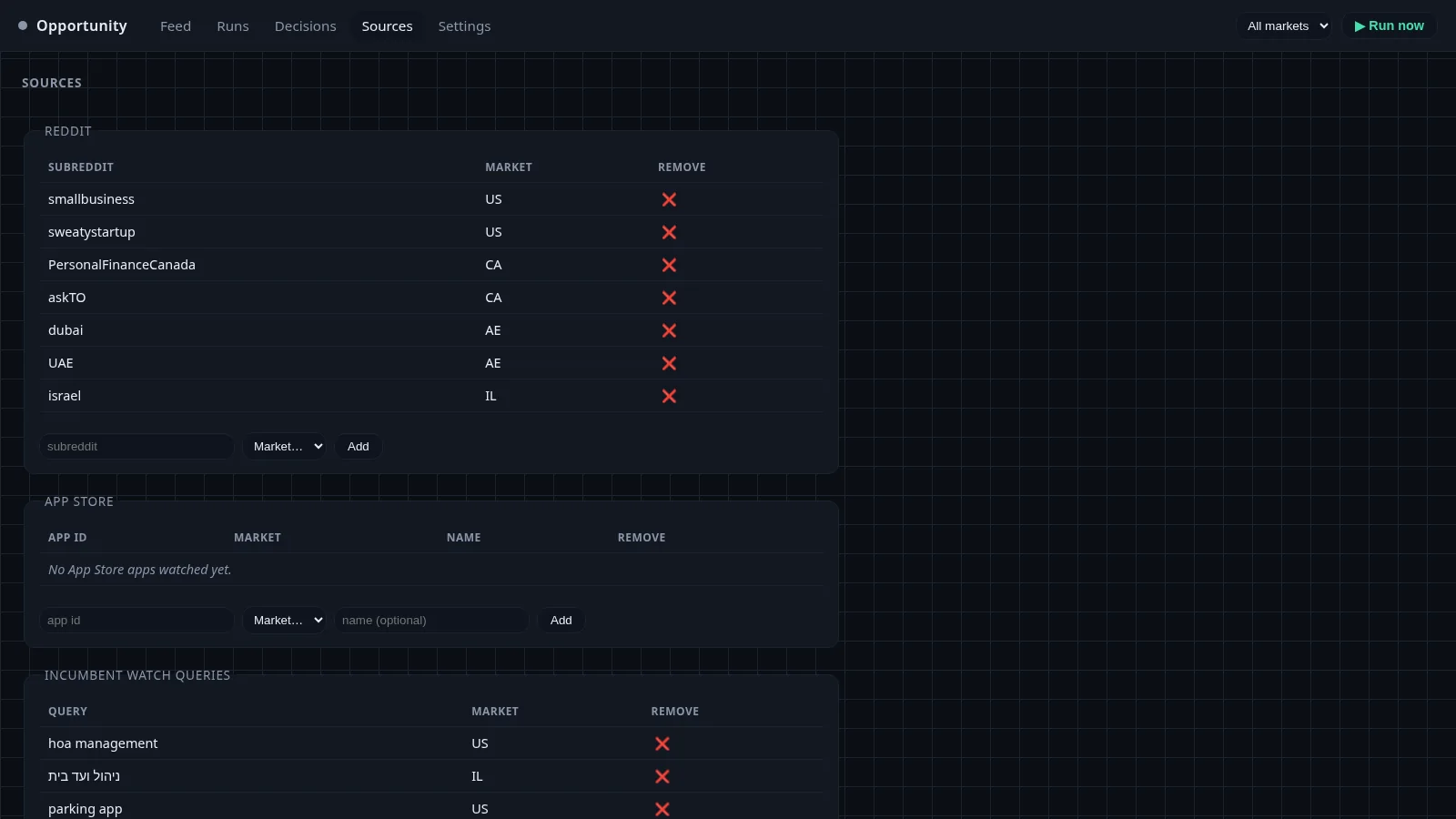
Multi-source collection
Reddit, Hacker News, Google Play/App Store reviews, incumbent scans and configurable public HTML sources.
A full-stack research system that collects public pain and demand signals, deduplicates and clusters them, scores success / money / effort, runs an adversarial Red Team and keeps the final product decision in a human workflow.
Opportunity research tends to scatter across posts, app reviews, search signals, competitors and manual notes. Opportunity turns that material into a repeatable pipeline: collect, filter, normalize, cluster, analyze, rank and challenge.
Instead of hiding the path to a score, the system keeps the evidence and its provenance and lets an operator drill into the exact quote, market, strength and weight that influenced a result.
Reddit, Hacker News, Google Play/App Store reviews, incumbent scans and configurable public HTML sources.
Pain-marker filtering, text normalization, duplicate detection and multilingual semantic clustering prevent the same pain from being counted repeatedly.
Success, money and effort scores are grounded in evidence components, followed by an adversarial review of stronger opportunities.
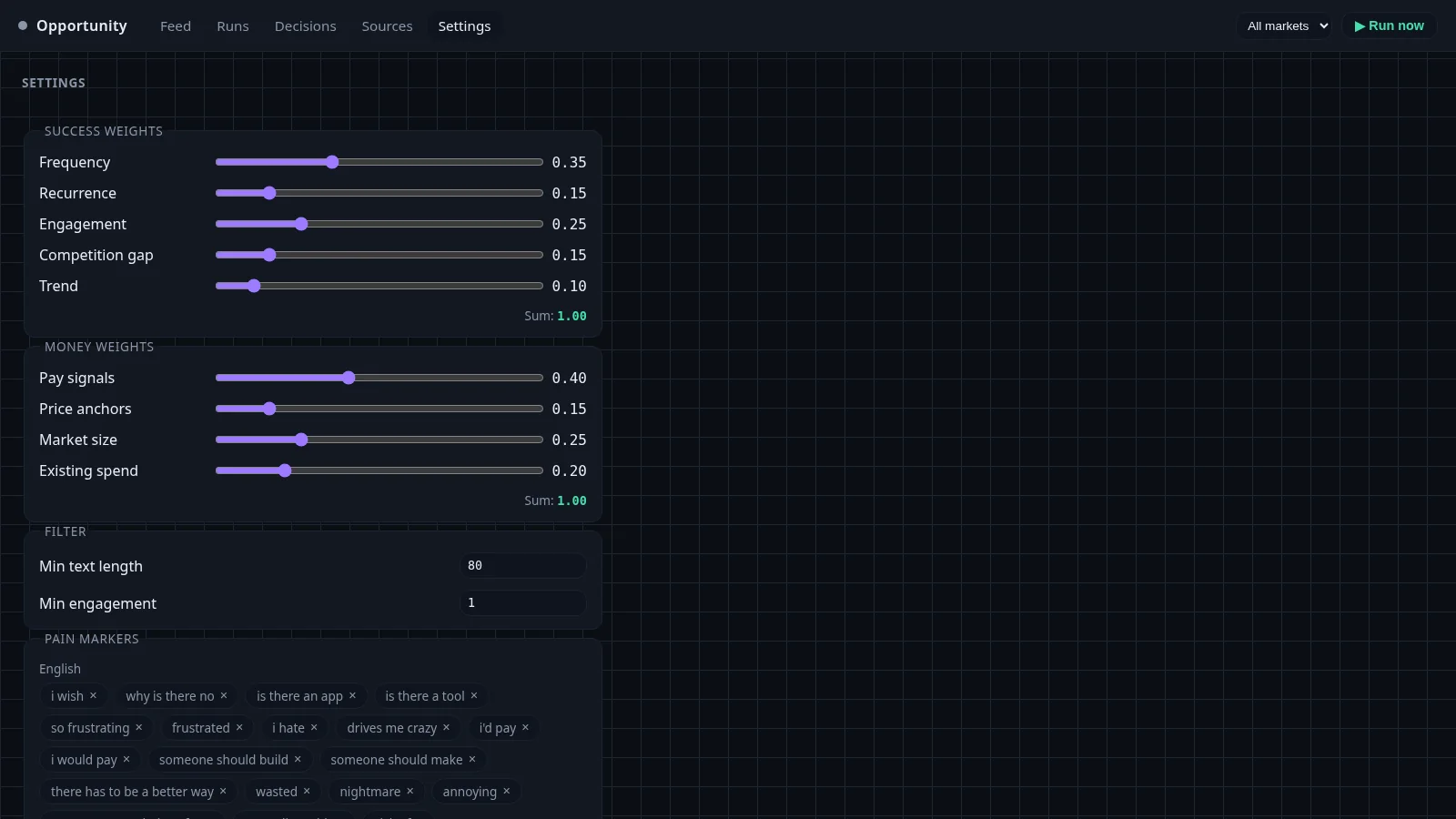
Reject / Interesting / Build, decision history, calibration and retrospectives — without delegating the product decision to the model.
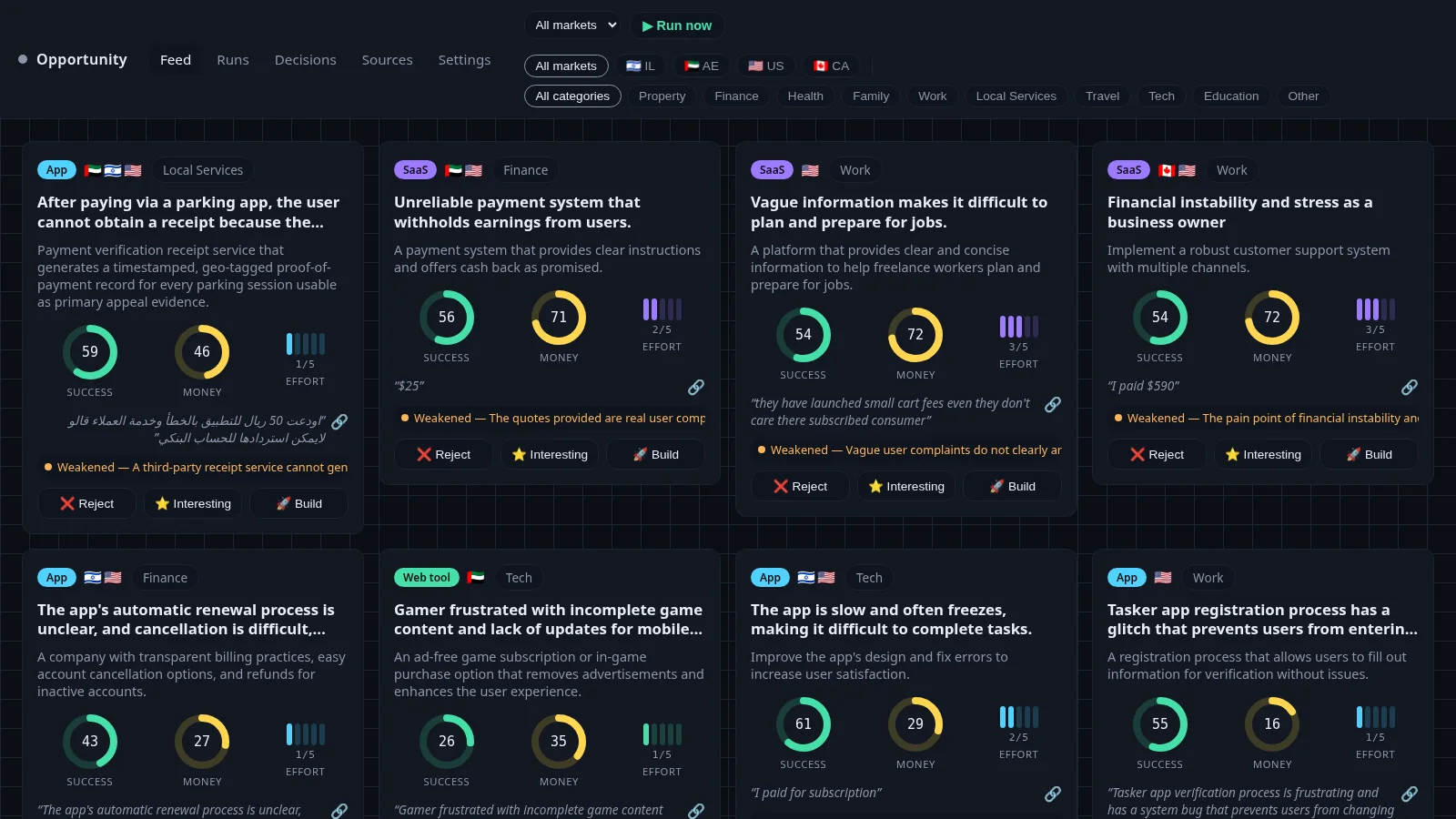
The feed brings together title, proposed solution, markets, category, success score, money potential, effort, strongest evidence quote, Red Team result and decision actions.
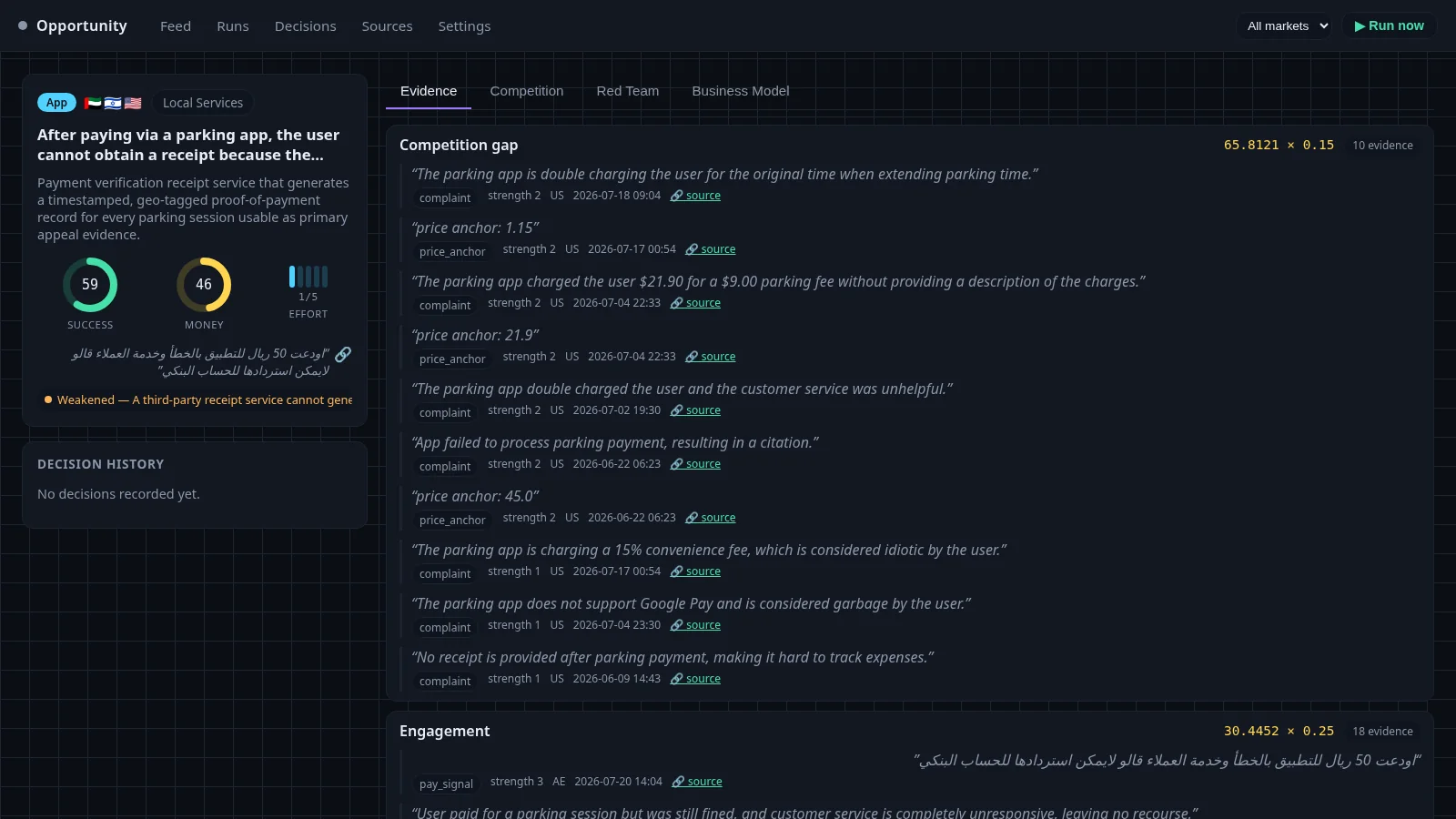
Each opportunity opens into an Investigation Board that breaks the ranking into evidence components such as competition gap, engagement, frequency, pay signals and price anchors. Evidence retains the quote, source, market and strength.
The same board connects Competition, Red Team and Business Model views, so moving from a pain signal to a business hypothesis stays inside one system.
Separate modules for Reddit, HN, app stores, forums, freelance, demand and incumbent scans, with per-source failure isolation.
Filter, normalize, geo-gap, cluster, analyze, score, red-team, business-model, calibration and retrospective are explicit stages.
A local war-room with Feed, Investigation Board, Runs, Decisions, Sources and Settings, plus Run Now and live stage status.
Evidence, opportunities, decisions and runs live in SQLite; weights, sources and LLM providers remain in transparent configuration.
The Red Team stage can reduce an opportunity's priority, while Reject / Interesting / Build remain operator decisions. Retrospectives produce review documents rather than silently rewriting weights or configuration.
Collection, AI, scoring, human review and a learning loop can live in one operational product.
Let's talkWeb product development at VERTEX FORTH →